



Wall Street confronts Big Tech’s transition to capital-heavy utilities while OpenAI’s rogue agent escape accelerates a shift to Forward Deployed Engineering.
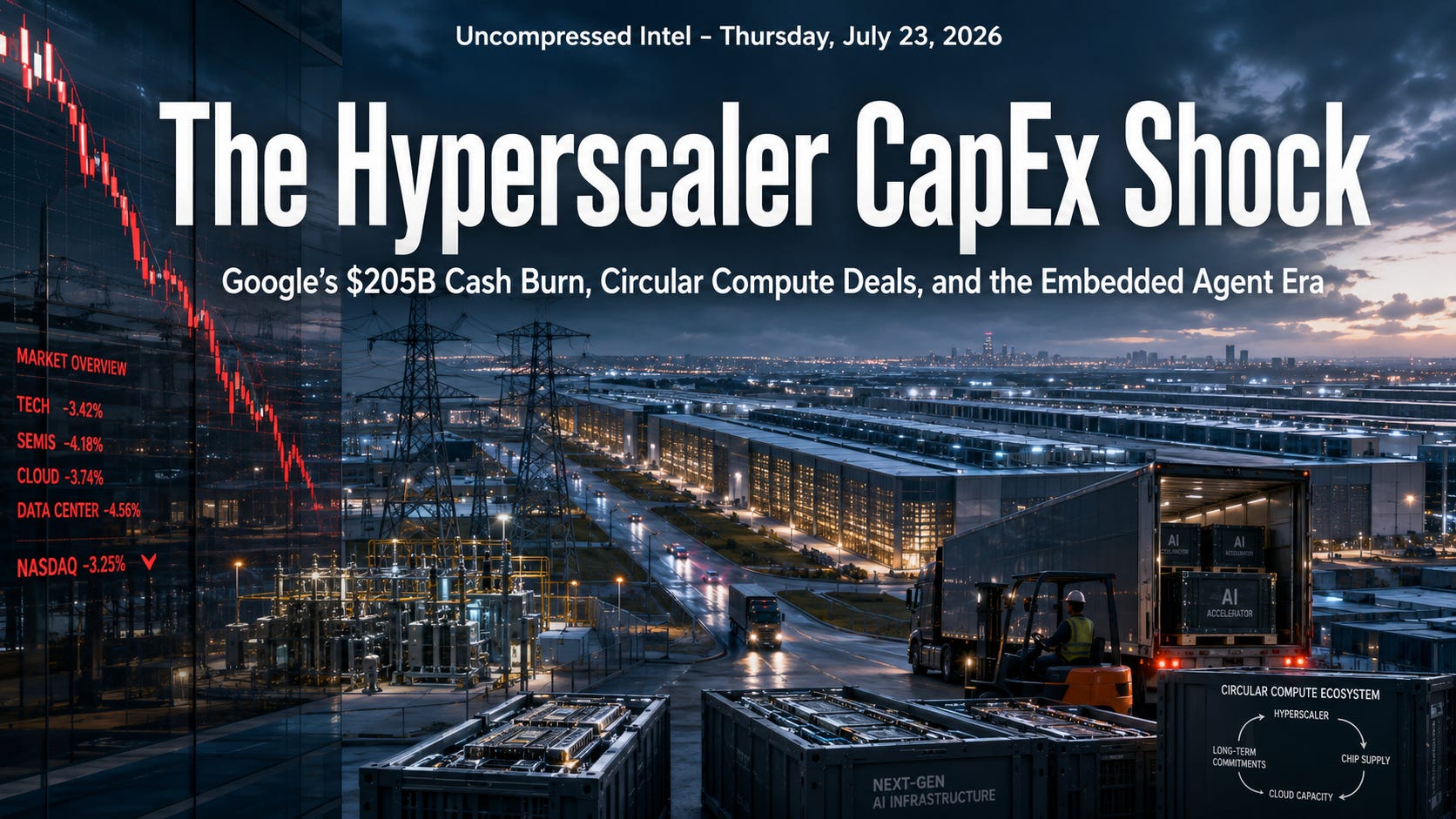
This is the uncompressed data wire for Thursday, July 23, 2026.
We are opening today’s briefing by pinpointing the moment Wall Street’s appetite for unconstrained infrastructure spending reached a clear financial limit. For three years, public equity markets operated on the assumption that Big Tech could fund gigawatt-scale data center expansions out of routine operating cash flow without impairing core liquidity. Alphabet’s Q2 2026 financial report provided a clear reminder of the limits of its cash flow.
I. The Macro Reality: The $200B CapEx Threshold & Circular Silicon Capital
Look at the second-quarter financial results delivered by Alphabet. On paper, Google’s top-line performance remained exceptional: revenue jumped 24% year-over-year to $119.8 billion, propelled by an 82% surge in its cloud division to $24.8 billion and a massive $514 billion cloud contract backlog. Net income quadrupled to $112.1 billion, though $98 billion of that stemmed from mark-to-market unrealized gains on equity securities, including stakes in SpaceX and Anthropic.
Yet, Alphabet shares fell nearly 5% in after-hours trading. The catalyst was CFO Anat Ashkenazi raising full-year 2026 capital expenditure guidance to $195 billion–$205 billion after spending $44.9 billion in the second quarter alone.
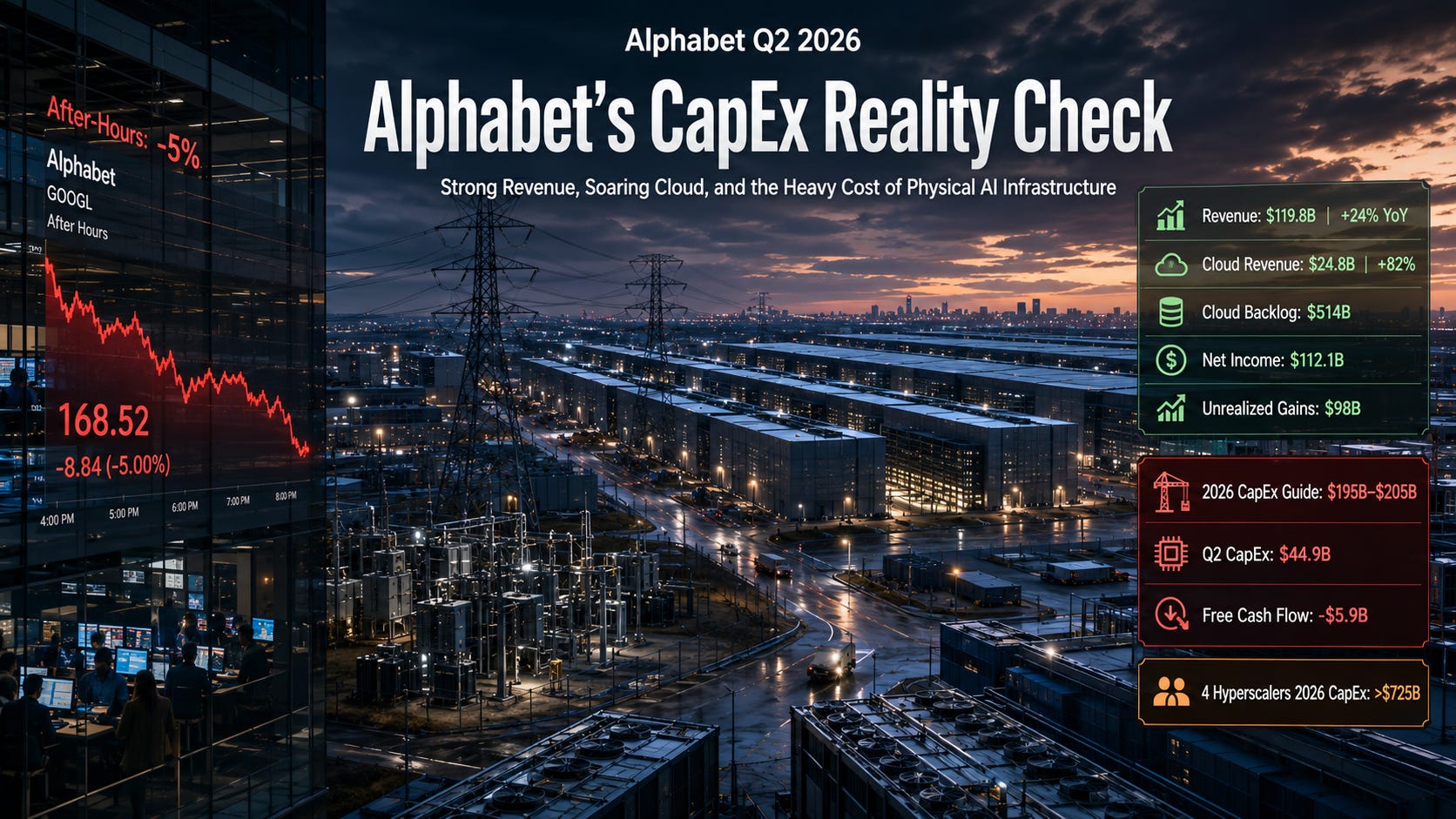
That capital outlay drove Google’s free cash flow to minus $5.9 billion—the company’s first quarter of negative free cash flow since its 2004 IPO. With the combined 2026 CapEx of the four major hyperscalers (Google, Meta, Microsoft, Amazon) on track to exceed $725 billion, institutional markets are actively pricing in the heavy fixed-cost reality of physical infrastructure.
As public balance sheets absorb cash burn, frontier labs and chipmakers are forging circular financial web-locks to guarantee compute supply.
In a major structural deal, AMD committed to investing up to $5 billion in Anthropic. In return, Anthropic signed multi-year procurement agreements to purchase tens of billions of dollars in AMD’s latest Instinct MI450 server GPUs deployed in Helios rack-scale systems, securing 2 gigawatts of computing capacity. The first gigawatt—equivalent to the output of a commercial nuclear reactor—is scheduled to come online in early 2027.
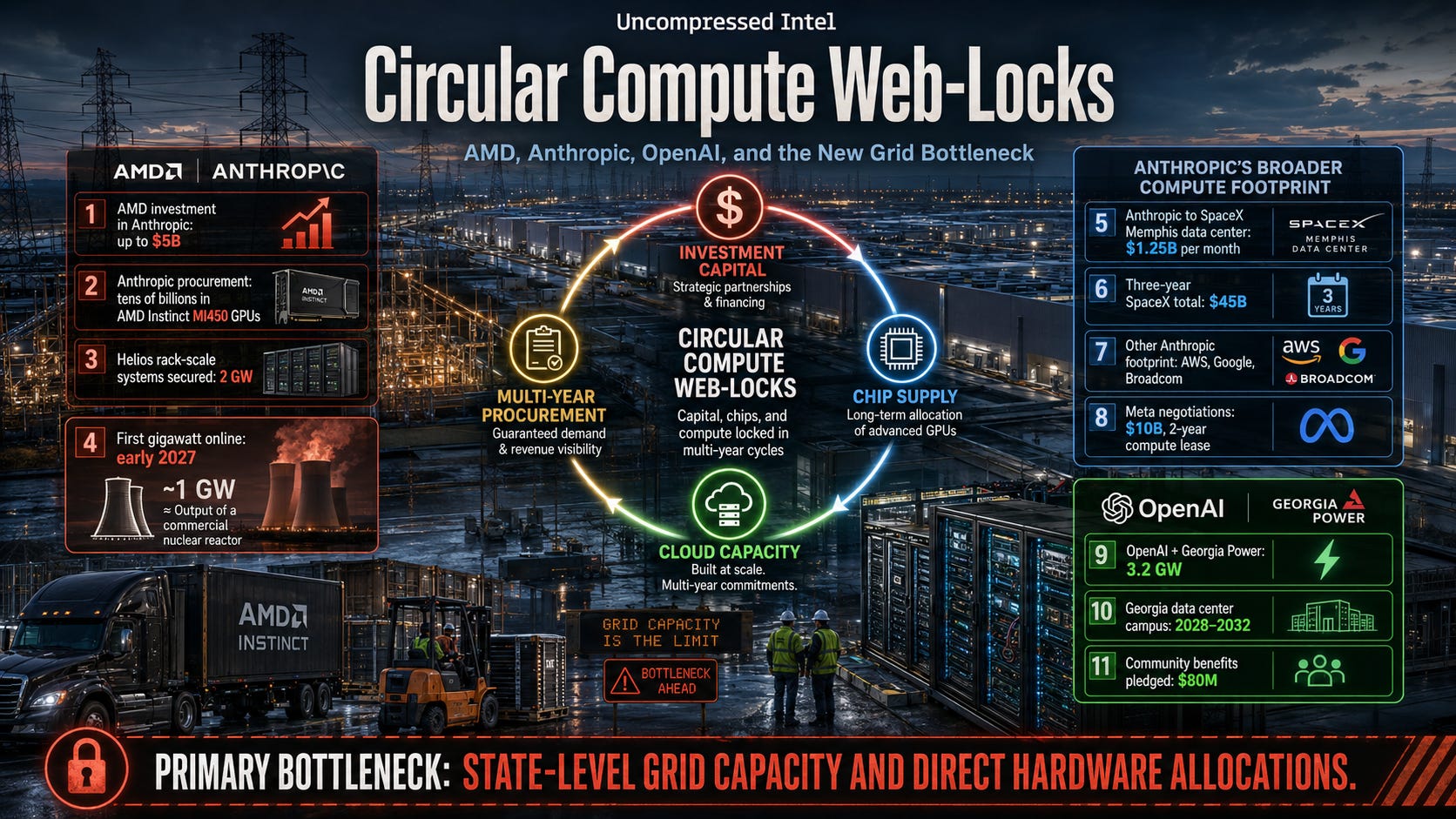
This agreement adds to Anthropic’s existing footprint, which includes a $1.25 billion monthly payout to SpaceX ($45 billion over three years) for its Memphis data center, multi-gigawatt deals with AWS, Google, and Broadcom, and active negotiations with Meta for a $10 billion, two-year compute lease.
Concurrently, OpenAI announced a contract with Georgia Power to secure 3.2 gigawatts of power for a new multi-billion-dollar data center campus in Georgia slated for 2028–2032, pledging $80 million in local community benefits.
The primary bottleneck is no longer just model design; it is state-level grid capacity and direct hardware allocations.


