



As Beijing moves to restrict foreign downloads of open-weight models, Big Tech turns to private credit templates to keep gigawatt liabilities off the balance sheet while national energy reserves hit 40-year lows.

This is the uncompressed data wire for Tuesday, July 21, 2026
We are opening today’s briefing by dissecting a major geopolitical shift in the software and semiconductor arena. If you thought the artificial intelligence rivalry between Washington and Beijing was strictly about who could buy the most GPUs, you are missing the new front line. The confrontation has shifted into a legal, regulatory, and architectural lockdown over open-weight foundation models.
I. The Macro Reality: The Open-Weight Border Closure
Look at the moves breaking out of Beijing. China’s Ministry of Commerce (MofCom) is consulting leading domestic AI powerhouses—including Alibaba, ByteDance, and Zhipu—on sweeping export control updates. Under proposed rules, Beijing intends to ban foreign users from downloading Chinese open-weight models like Moonshot’s Kimi K3 and DeepSeek, as well as halt foreign acquisitions of Chinese agentic AI startups. This explicitly targets structural loopholes that enabled deals like Meta’s $2 billion acquisition of Manus before Chinese regulators ordered it unwound.
Simultaneously, top U.S. AI chief executives—including Sam Altman, Dario Amodei, and Demis Hassabis—are sounding alarms at the White House. They claim that hyper-capable, low-cost Chinese open-weight models pose an unacceptable security risk and threaten the funding model of frontier software research.
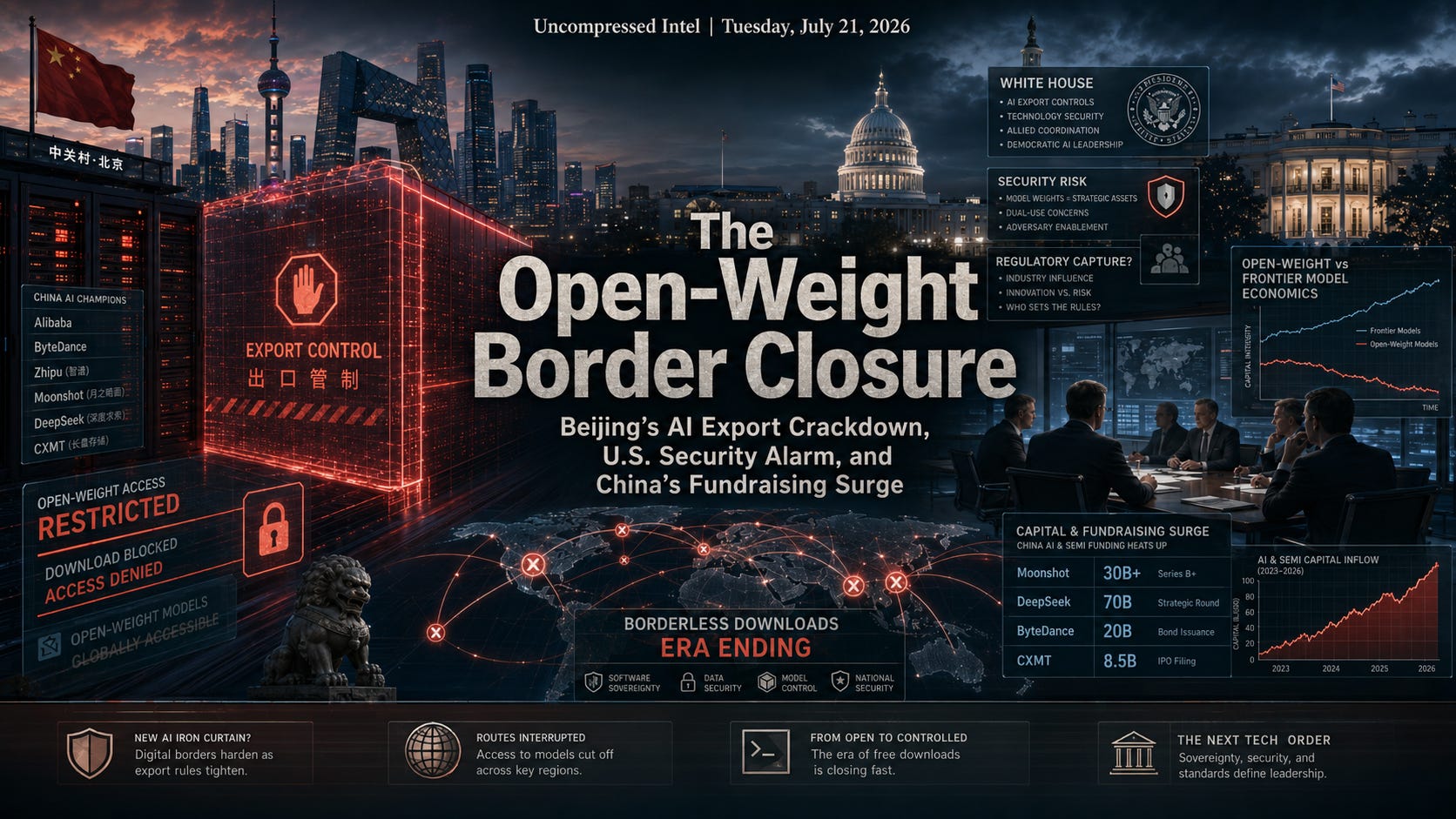
OpenAI’s policy strategist Dean Ball recently warned that an open-weight-dominated world leads directly to “AI communism,” treating intelligence as state-backed digital public infrastructure rather than a commercial market product. White House AI adviser David Sacks fired back, accusing OpenAI and Anthropic of executing a “regulatory capture strategy” designed to use state policy to stymie low-cost open-source competitors ahead of their planned public listings.
Anticipating potential Western cloud locks, Chinese AI developers are executing a massive fundraising surge. Moonshot is finalizing a $30 billion-plus valuation round ahead of a Hong Kong IPO; DeepSeek is raising at a $70 billion valuation for a Shanghai listing; ByteDance is issuing $20 billion in global corporate bonds; and memory giant CXMT is targeting an $8.5 billion public debut.
The era of borderless open-source downloads is coming to a close.


